

Posted on Monday June 7th by Melissa Lafsky | 1,561

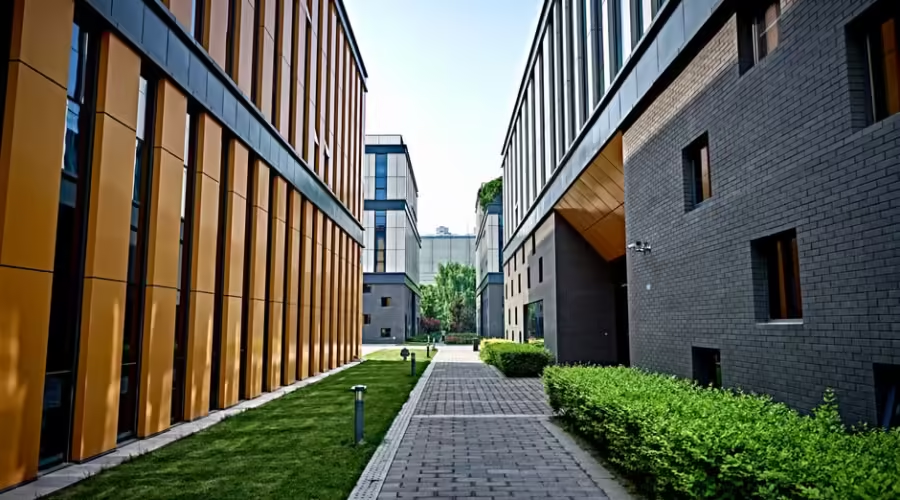
gas-maskAmidst all the debate over whether they bring any benefit — not to mention how much they cost — one point may be getting lost: Are LEED buildings in fact safe to live/work in? A new report from the nonprofit group Environment & Human Health, Inc. (EHHI) argues that the U.S. Green Building Council’s LEED rating system, which is of course intended to promote energy efficiency, is in fact resulting in buildings filled with “unhealthy” air.

The reason, the study claims, is that the LEED system favors said energy efficiency over indoor air quality. Many corporations and businesses have adopted LEED standards quickly and painlessly, without necessarily understanding that the tactics used for energy conservation have a side effect: They often reduce the exchange of indoor and outdoor air within a building, which can cause synthetic chemicals to become concentrated inside. According to an EHHI press release:

EHHI is especially concerned that the LEED programme is now providing the false impression that the buildings it certifies protect human health. LEED’s highest rating, Platinum, is attainable without earning any credits for indoor air quality protection.

And as John Wargo, lead author of the study, and Professor of Risk Analysis and Environmental Policy at Yale, points out: “Although LEED has effectively encouraged energy efficiency in buildings, tighter buildings often concentrate chemicals released from building materials, cleaning supplies, fuel combustion, pesticides and other hazardous substances.” These chemicals are no joke — there’s the ever-controversial phthalates used in walls and floors, the perfluorinated chemicals found in most office carpeting, and the short-chain chlorinated paraffins found in flame retardants.

Granted, there’s an underlying point to be made here: Non-LEED buildings are being constructed and filled with the exact same chemicals (and chances are, if you’re reading this from your office, you’re surrounded by them right now). The difference being highlighted here is that, in LEED buildings, there’s less air circulation, so the concentration of these chemicals is somewhat higher. And while every one of the above-named chemicals is listed as “of concern” to the EPA, toxicology studies are still unclear as to what, if any, level of exposure is harmful to humans.

We’re not suggesting that it’s necessarily a good idea to breathe in any or all of these substances every day. But it’s worth asking, do the environmental benefits of a LEED building counterbalance, if not outweigh, the possible health threats of a group of chemicals the effects of which remain largely unknown?

8 Responses to “Are LEED Buildings Filled With Toxic Air (Any More Than Regular Buildings)?”

  1. Rockfish Says:

    That’s not entirely accurate. LEED-certified buildings may in fact have better fresh air circulation than conventional buildings. It’s misleading to state that LEED automatically means the air is less healthy. LEED in fact requires that all projects meet ASHRAE 62.1-2007 requirements for ventilation. While not perfect, this is better than most building code minimums.
    However, it is a very valid criticism that LEED doesn’t mandate more substantial indoor air quality improvements in every building it certifies. It would be good if they required a certain amount of improvement (points) in all categories, at least for their ultimate “Platinum” award.

  2. Daniel Says:

    I’ve wondered about this, so it’s interesting to see a study on the topic. I had a landlord once who insulated the heck out of the house we rented from him. He had solar panels on the roof and really took the energy-efficiency concept seriously, which I respect. The trouble is that we ended up waging an ongoing war against mold, which can lead to health problems and/or interior damage if its not dealt with. I can’t make the connection conclusively, but I suspect the lack of ventilation had something to do with this. Thankfully, we no longer live there.

  3. Natalie Says:

    I just finished an entire course on the LEED rating system this semester and while it’s true that LEED does encourage tighter construction and therefore less leakage if you will of indoor air, there are also a huge emphasis on cutting out all of the toxic substances mentioned in the article above. LEED has an entire section dedicated to Indoor Environmental Quality and this includes greatly reducing or eliminating many of the toxic substances listed above including VOCs from paint and sealants, formaldehyde that commonly holds together particle board, and a clear statement supporting the use of natural cleaners indoors as a comprehensive way to get these substances out of our lives and to recover some of the initial costs of a LEED certified building.

    I’m not sure the group that did this study has all their facts straight.

  4. Michael Says:

    Most American buildings, not just LEED buildings, could do well to improve their indoor air quality through strategically selected plants. In sufficient quantity, plants can even reduce a building’s energy consumption profile, by reducing the need for outside air intake. A 2009 TED talk by Kamal Meattle goes further into details, although the particular case described — completely replacing outdoor intake in the heavily polluted air of Delhi — is a somewhat extreme application of the concept.

  5. Chris R Says:

    Whereas this study (or at least this article) missed the point, Rockfish hit the nail on the head. LEED buildings are far from perfect, but they do adhere to the ASHRAE standard and local building codes. THAT’S where attention should be focused for improving IAQ - as well as on reducing the use of toxic chemicals in commercial environments.

  6. eCaerus Says:

    While many agree LEED has shortcomings, it is continually improving and reports like this do contribute. It is a higher standard than most building codes that challenges owners and design teams to look differently at the process and selections. Integrated design is encouraged and building commissioning mandated, which is often omitted on small or mid size projects. Not perfect but better than nothing?

  7. Nathanael Says:

    Seriously, do people build LEED buildings without HRVs?

    Best recommendation (for a whilte now!) is to make buildings very tight and put in mechanical ventilation with heat recovery.

    A tight building *requires* a heat recovery ventilator.

    Plants are really valuable too.

  8. LEED Criticisms | Dispatches from Life Says:

    [...] a whole hullabaloo (and that’s just one relatively respectful article) in the green building community these [...]

Post a comment: