
Posted on Thursday March 26th by Yonah Freemark | 4,404

germany-hsrObama’s $8 billion gambit for high-speed rail in the stimulus package may be the country’s largest-ever investment in its railways, but America is still decades behind the curve when it comes to fast trains. We reviewed the state of the high speed rail in other countries around the world, and came up with this ranking of the best networks. We could do a lot worse than to emulate any one of them.

7. Germany

Germany began developing its high-speed rail program just after France introduced its own in the 1980s, but though InterCityExpress (ICE) trains are a common sight on the Teutonic landscape, they rarely run at their maximum speeds. In fact, though Germany is Europe’s biggest economy, it only has two rail lines operating at speeds of 180 mph or above: between Frankfurt and Cologne and between Munich and Nuremburg. Much of the rest of the country is connected via lines running at about 120 mph. The result are relatively slow travel speeds: the trip between Munich and Berlin takes almost six hours, compared to three on a similar-distance Paris-Marseille TGV.

ICE trains were subject to major mechanical flaws in the late 1990s, culminating in the Eschede disaster in 1998, when a train slammed into a bridge at full speed, killing more than 100 people. The problem was the German train operator’s lack of maintenance on the steel wheels, which were subjected to excessive wear and tear; a crack developed on a ring surrounding the wheel, eventually causing it to dislodge and push the train off the tracks. (It should be noted that since then there has not been a major accident on the German rail network and that, in general, high-speed rail is one of the world’s safest commuting options, with a perfect record in France, Japan, Spain, and Italy. Germany’s experience was a rare deviation from the norm.)

6. Italy

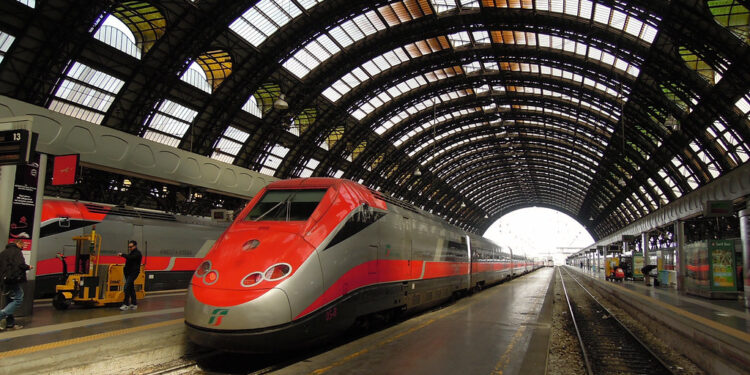
Italy isn’t often given credit for its efforts, but it was the first country in Europe to offer high-speed rail, starting in 1978 between Rome and Florence. Until recently, however, the network hasn’t been expanding very quickly, with Venice and Genoa consistently left out of the fold and the Rome-Milan line severely limited because of delays between Florence and Bologna.

But the opening last year of the new link between Milan and Bologna has cut the travel time between the cities in half to just 65 minutes. And connections south of Naples and north of Florence are in construction, as are links north to Austria through the giant Brenner Base Tunnel and west to France through the planned Lyon-Turin link.

Italy’s transportation future may lie in privatized high-speed rail lines, since it will be the first country in Europe to offer such service. Nuovo Trasporto Viaggiatori will use brand-new Alstom AGV trainsets to compete directly with the state-run lines beginning in 2011.

5. Japan

In 1964, Japan began operating the Shinkansen, the world’s first high-speed trains, between Tokyo and Osaka. Today, the country’s network extends almost 1,500 miles, from Tokyo north to Hachinohe and south to Hakata; new lines extending the network west to Kanazawa, south to Nagasaki, and north to Sapporo are in the planning phase.

The most important route, running from Tokyo to Osaka, often sees overcrowding, forcing some trains to operate at 200% capacity. But the network simply cannot handle more vehicles – they already operate every five minutes at peak periods – so the country is busy developing a maglev line that will parallel the existing route. Unfortunately, it won’t be ready until 2025.

As excellent as Japan’s rail system is, the privatization of the railways in 1987 into six separate entities, all managing distinct portions of the network, makes through connections between different parts of Japan difficult, sometimes requiring a train change on routes that should be direct.

4. Taiwan

Taiwan opened its high-speed rail line, which runs the length of the western coast of the country, only two years ago, but it has been so successful that competing bus and air service has already been scaled way back. That’s because the Taiwan High Speed Rail Corporation runs trains at 180 mph and reduced the travel time by rail from Taipei in the north to Kaohsiung in the south from 4.5 hours to just 90 minutes.

The project was subject to a number of problems, including an internal battle over whether European or Japanese technology would be used for the line (the latter was ultimately picked). Its construction was also marred by an electrical system breakdown. But its operation has been problem-free.

The country’s $15 billion investment in fast rail services was significant, but the project was tolerable for the nation’s pocketbook because 80% of the total costs were covered by private investors. The private company that runs the service is already operating at a profit and slowly but surely paying back initial capital costs. Along with being a boon to travelers, Taiwan’s high-speed railway makes economic sense.

3. France

France’s Train à Grande Vitesse (TGV) is probably the best-known brand in high-speed rail because the service, which first opened for the public in 1981, has been consistently reliable, fast, and convenient. Now the network, extending in all directions from Paris, ensures that the vast majority of French citizens have easy access to their capital - which explains why the service attracts 100 million passengers a year. International high-speed connections to England, Germany, and Belgium are in service, and fast links to Italy and Spain are under construction. France’s network already forms the backbone of the European rail network, a status that is expected only to improve in the coming years with the completion of more track.

France is investing quickly in new lines, hoping to speed services between the provinces, rather than just to and from Paris. Lyon will be getting a line north to Strasbourg on the German border, and Toulouse, which currently lacks a high-speed link, will be connected directly to Bordeaux. Meanwhile, TGVs are likely to get faster, with tests in 2007 pushing a modified train set to speeds of 345 mph.

TGVs offer speedy service - the trip between Paris and Marseille, at 450 miles, can be completed in just three hours - but what makes French rail really special is its accessibility. Since the first line was inaugurated, the French government has operated the trains under the motto “TGV pour tous,” meaning fast rail for everyone. As a result, the trains aren’t luxurious, but they’re comfortable and cheap enough for anyone to ride. That’s especially true because of the national rail company’s discounts for the poor, the young, the old, the sick, and large families. There’s little cost incentive in France to take the slow train.

Even so, the national rail company made over a billion Euros in profit in 2007 and half a billion in 2008, even as the economic crisis started to bite. France’s example shows that it is possible to imagine fast railways that are accessible to the rich and to the poor, for travel over short and long distances, that don’t break the national bank.

2. China

It’s hard to believe that China’s first high-speed train began operating last year. By 2020, the Chinese government plans to have constructed 8000 miles of a fast rail network. Focusing on the country’s heavily populated eastern seaboard, trains will operate at 180 mph and above between Beijing and Shanghai and Hong Kong, and between Xuzhou and Lanzhou and Hangzhou and Changsha. Meanwhile, many of the other major cities in the country will be upgraded to 120 mph operation.

The 800 mile Beijing-Shanghai line, which will open for operations next year, and will reduce travel time from 14 hours to 5, attracting an estimated 220,000 daily passengers and should dramatically reduce air travel between the metropolises.

Shanghai’s maglev system, which began operations in 2004, connects the city center with the airport some 30 km away. The trains travel up to 431 km/h on regular runs, making it the fastest operating passenger railway in the world. An extension to Hangzhou, the city’s other airport, is under consideration.

Though China has signed several huge contracts with Germany’s Siemens for hundreds of high-speed trainsets, the expansion of high-speed rail has also inspired the growth of native Chinese rail manufacturers, which are also selling some of the system’s rail vehicles. Not only will high-speed rail make travel faster and more convenient in China–it’s also foster scientific ingenuity and a new domestic industry.

1. Spain

In 1992, Spain’s first high-speed rail link opened between the capital in Madrid and the southern city of Seville. In the intervening years, the country has invested significantly in its AVE high-speed rail services, building lines southeast from Madrid to Malaga, northwest to Valladolid, and west to Barcelona. Those extensions have already given the country one of the world’s largest fast rail networks, but it’s what Spain is planning for the years ahead that makes its program the world’s best.

By 2020, the country will have 10,000 kilometers of high-speed lines all within a land area smaller than Texas. Spain’s Strategic Infrastructure and Transportation Plan goes a step further by encouraging transporting freight on rail, pushing back against the steady drift towards road transport of freight in Europe in recent decades.

Finally, Spain’s program emphasizes interconnectivity with its neighbors France and Portugal, with which it shares open borders. These connections, including a cross-border tunnel north of Barcelona currently under construction, will allow the nation’s citizens easy train access to the rest of Europe. Even more exciting is a plan to build a tunnel under the Mediterranean to Morocco, a project yet to be funded but which would dramatically alter relationships between Europe and Africa.

Yonah Freemark is an independent researcher currently working in France on comparative urban development as part of a Gordon Grand Fellowship from Yale University, from which he graduated in May 2008 with a BA in architecture. He writes about transportation and land use issues for
The Transport Politic and The Infrastructurist.

(Photo: DB Presse)

23 Responses to “The World’s 7 Best High Speed Rail Networks”

  1. Mike Says:

    Why does Japan miss the list?

  2. admin Says:

    An editorial cut and paste error. Japan is number 5 on the list. Thanks for bringing that to our attention.

    -Jebediah

  3. WestIndianArchie Says:

    Great list. I hope the Cato institution guys see this.

  4. World’s best high speed rail networks | Says:

    [...] a leader in wind power, is #1 in high speed rail too. Sadly, the US is nowhere to be seen. High speed rail can often substitute for air travel, maybe [...]

  5. TrainsInTokyo Says:

    “As excellent as Japan’s rail system is, the privatization of the railways in 1987 into six separate entities, all managing distinct portions of the network, makes through connections between different parts of Japan difficult, sometimes requiring a train change on routes that should be direct.”

    For example? One can reach every end of the shinkansen network from Tokyo without changing trains once–except for the Kyushu shinkansen, but only because the portion currently open is discontinuous from the rest of the network for the moment. Aside from that, though, I’m at a loss to come up with another example.

  6. (^ω^) Says:

    re TrainsInTokyo:
    The only logical examples are between stations in different directions from Tokyo, as in Sendai - Nagoya or Niigata - Nagano. But by this standard, through connections between different parts of Spain, France, and Germany are also difficult, sometimes requiring a train change in Madrid, Paris, and Hannover.

  7. April 2009 TunnelProject TunnelNews and Tunnel Projects | tunnelproject.com Says:

    [...] TunnelNews and Tunnel Projects Published by admin on April 1, 2009 in TunnelNews. The World’s 7 Best High Speed Rail Networks » INFRASTRUCTURIST And connections south of Naples and north of Florence are in construction, as are links north to [...]

  8. Davsot Says:

    Agree 100%.

  9. Time to be Driving a Platinum Spike? | Orange Juice! Politics For The Rest Of Us. Says:

    [...] http://www.infrastructurist.com/2009/03/26/the-worlds-7-best-high-speed-rail-networks/ [...]

  10. ron Says:

    RIDCULOUS ranking! CHINA is a very nascent network, while KOREA is xcluded! Please invetsigate KOREAN hi speed rail!
    WHy is CHINA ranked ahead of Japan and FRANCE???

  11. Obama Pushes Vision for High-Speed Rail - Page 33 - Political Forum Says:

    [...] [...]

  12. Pham Says:

    I concurred with Ron. China doesn’t even have comparable high speed technology of its own to deserve a 2nd spot. Many of its railing technologies were built by foreigners. Anyhow, I think Japan, France, Germany and Italy should ranked in the top four.

  13. Peter Says:

    This is a nice attempt, but there are various things that should be pointed out. First, Korea should be on the list as already indicated by others. Secondly, it is also interesting to note that Germany’s ICE is viewed quite negatively when, in fact, the ICE is the basis for China’s rail system as well as Spain’s. Building a fast rail system is one thing; making it commercially successful is something different; maintain political and public support yet another. China is the odd ball here, because the build up of the rail system is a political top down decision that has nothing to do with public support. From that end, Japan, Spain and France have done an excellent job in aligning all aspects. It is also important to note that only dense population countries and the willingness to invest oodles of money have been successful in implementing such a rail system. Thus, the US will face yet a completely different scenario since it is neither heavily populated (at least in its vast interior) nor will it be easy politically to invest the money needed to build the network. Thus, the US needs to use the existing network and accelerate using possibly tilting trains (here, Italy has the edge).

  14. laughs Says:

    Good attempt by the author of trying to compile of list of obviously complex situation. Comments from the other commentators, a bunch of ignorant idiots. Don’t do it again, idiots.

  15. gi Says:

    good attempt, but i think that you should investigate italys network, eurostaritalia. While its not at as developed as others, they have the edge in tilting technology as laughs said. While some length of track is limited to pathetic speeds, trains going between florence and bologna have clocked 220 mph

  16. Kim Jong America Says:

    POOHH GI! NORTH KOREA HAS BEST HSR! WE HAVE TRAIN GO 222222222222mph
    and yo poops like gi will say i troll

  17. gi Says:

    Kim jong america is a troller!
    wow he is such a troller. the nkpd doesnt even have hst

  18. Tom Says:

    Bologna is one of the most amazing places in Italy!

  19. High-speed rail projects awarded funding - MBWorld.org Forums Says:

    [...] a nice article about Hi Speed lines overseas. Not all of them have delivered on their promise. http://www.infrastructurist.com/2009…rail-networks/ __________________ Ik [...]

  20. CrazyHSR Says:

    Untii 16/3/2010, China has a total 6552 Km high speed rail done for commercial operation.(New lines+ old lines upgrated). Ranked NO 1 in the world.

    Official statistics from MOR,China.

    1.New lines : 3676 KM

    A: 350KM Speed: 1694 KM.(Pekin-Tianjin, Wuhan-Canton, Zhengzhou-Xi’an)
    B: 250KM Speed : 1982 KM (Hefei-Nanking, Hefei-Wuhan,etc.Total 7 short lines)

    2.Under Constrcution: More than 10,000 KM (Pekin-Shanghai,Harbin-Dalin Pekin-Shijiazhuang,etc) .All
    will be done on 2012.

    3.Existing old line upgraded to 200-250KM Speed since 04/2007: 2876KM.(old Pekin-Harhin,old Pekin-Shanghai,etc)

    Meanwhile Korea only has 240 KM HSR.

  21. gi Says:

    now, one more post on the forum. I beleive there is one country you have missed out completely on this list. Guess what it is? Portugal. The alfa pendular is a etr 460 derivatave that may only travel at 130 mph but fosters a specific type of quality; financial solvency. In a coutnry with an economy like portugals, they have created an hsr that gets the job done. JOB WELL DONE!

  22. gi Says:

    if one of you peeps put acela on this list i will murder you mercilessly. Ithink the turbotrain is better than the acela.

  23. J Says:

    Korean railroad has the highest speed.

    Korea Train Express (KTX) runs at a speed of 305 km/h normally.

    Wikipedia says it.
    (http://en.wikipedia.org/wiki/Korea_Train_Express#cite_note-sbs-42)

    If you do not trust Wikipedia, then go to this link:
    http://translate.google.com/translate?u=http://news.sbs.co.kr/section_news/news_read.jsp%3Fnews_id%3DN1000709822&sl=ko&tl=en&hl=&ie=UTF-8

    It is the google translated version of “http://news.sbs.co.kr/section_news/news_read.jsp?news_id=N1000709822″ which is, as you can see from the address, SBS (Seoul Broadcasting System) of South Korea.

    According to the official KTX announcement, the maximum speed of KTX is 330 km/h. incredible, right?

Post a comment: